CCC IN TROUBLE: INTERNAL FIGHTS AND SECRET PLANS
The main opposition party in Zimbabwe, the Citizens Coalition for Change (CCC), is facing big problems. Many people think a new group inside the party is causing these problems. But this group, called the interim steering committee, is not new. It has been there from the start of the fights inside the CCC.
The committee is led by Dingilizwe Tshuma, a former Member of Parliament (MP) for Entumbane-Njube in Bulawayo. This group has played a big role in removing other CCC members from their positions. These removals have not only made the party weak but have also divided it. What was once a strong party is now broken into small pieces.
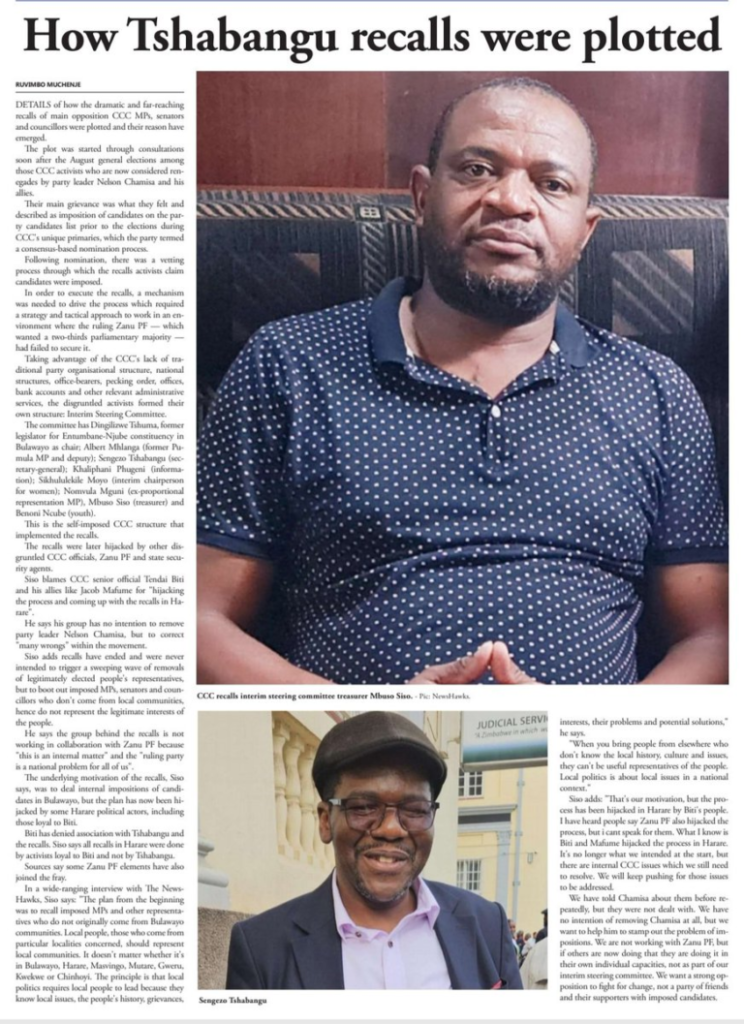
The steering committee has many important people in it. Besides Tshuma, it includes Albert Mhlanga, a former MP for Pumula, who serves as the deputy chair. The secretary-general is Sengezo Tshabangu. The person responsible for information is Khaliphani Phugeni. Sikhululekile Moyo is in charge of women’s affairs, while Nomvula Mguni, a former MP, also plays a key role. Mbuso Siso takes care of the party’s money, and Benoni Ncube is responsible for the youth wing. These people know a lot about politics and how the party works, making them very powerful.
This committee did not just remove a few people from the party. It started in Bulawayo, but later, other CCC members who were unhappy, as well as people from the ruling party Zanu PF and government security agents, joined in. Together, they used these removals to cause bigger problems inside the CCC. Their goal was clear: to destroy the party from inside.
The results have been very bad for the CCC. Many Zimbabweans saw the party as a strong alternative to Zanu PF. But now, it looks weak. People who used to support it are now confused and disappointed. If the party cannot control itself, can it really run a whole country?
But this is not just a fight inside the CCC. There is something bigger happening. Zanu PF and government security agents are also involved. They are using the problems inside the CCC to make it weaker. They want to keep power by making sure the opposition is not strong enough to fight them in elections.
The CCC is now in a very difficult position. The problems inside the party are not new, but they have become worse. This is a big moment for Zimbabwe’s politics. What happens next will decide not just the future of the CCC, but also the future of Zimbabwe. If the CCC can fix its problems, it may still have a chance. But if it continues to fight itself, it may not survive.


Your analysis leans too heavily on the idea that external forces, like government security agents, are orchestrating the division within the CCC. Without solid evidence, this portrayal feels more like speculation than fact, and it undermines the complexity of internal party dynamics.
You exaggerate the impact of the interim steering committee’s actions. It’s oversimplified to claim that this group alone is dismantling the CCC. Internal debates happen in every party, and your narrative ignores that some of these conflicts might eventually lead to needed reforms rather than complete collapse.